
 EN

Two cappuccinos are ready on the counter. One contains oat milk, the other dairy milk. Both have been made correctly.
The barista calls out “cappuccino”, and the customer nearest the collection point takes the first cup. Nobody notices the mistake until the second customer asks where their oat cappuccino has gone. If a milk choice is linked to an allergy, the mix-up may be more than an inconvenience: staff must check the ingredients and cross-contact risks before serving a replacement, not simply swap cups that customers have already handled.
The espresso machine worked. The orders were taken correctly. The drinks were prepared as requested. Yet the café still has a problem to fix, an unhappy customer to serve and a queue that has grown while everyone tries to work out what happened.
This is one of the less obvious difficulties of running a busy coffee shop: making good coffee and managing the journey from order to customer are two different skills.
You don't necessarily need another barista, a faster till or a new ordering system. First, you need to know where an order stops being identifiable.
A coffee shop has three queues, even when you can only see one
When the morning queue reaches the door, the natural instinct is to get people through the till faster.
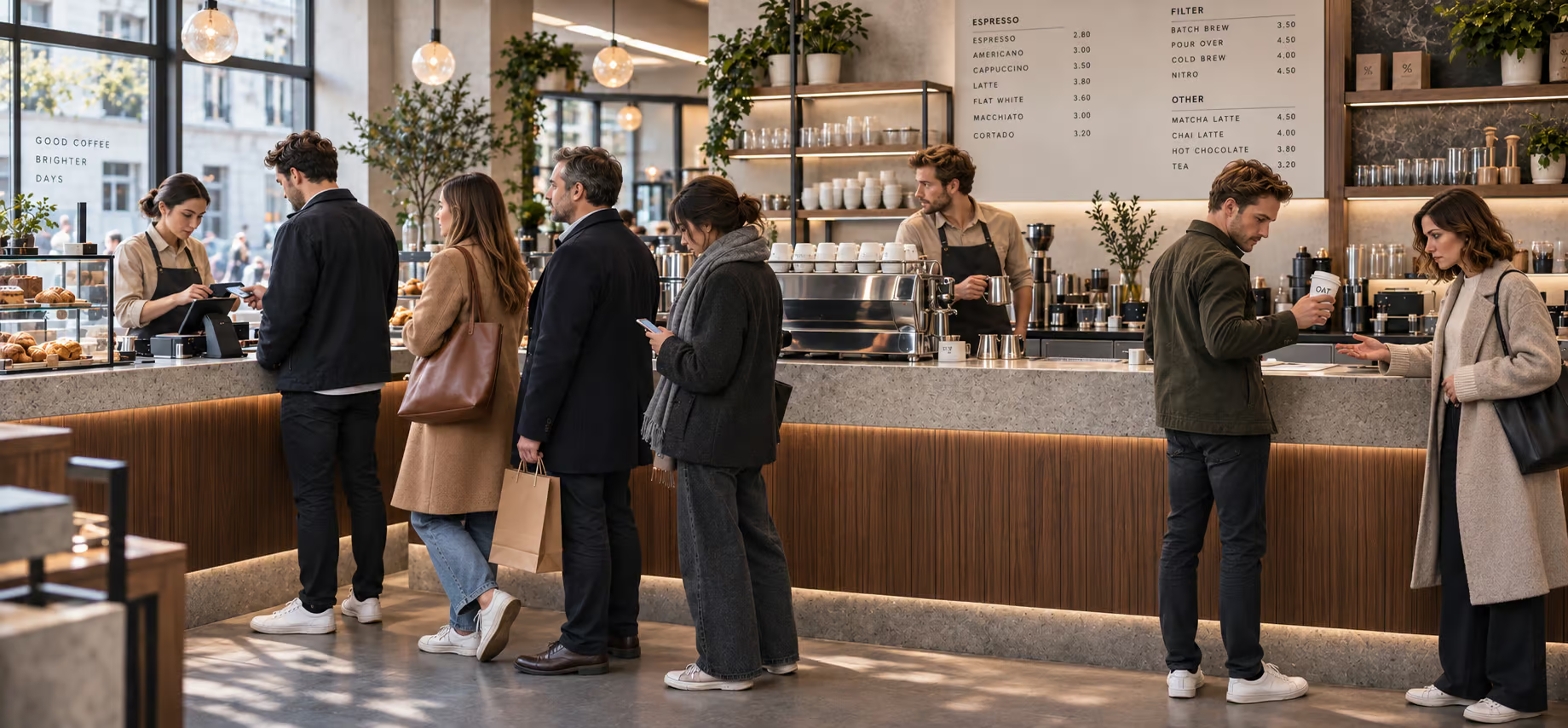
But the visible queue is only the first part of the operation.
There are actually three different groups waiting:
- Customers waiting to order. They need to choose, ask questions and, depending on the service model, pay.
- Orders waiting to be prepared. The barista needs the right drink, size, milk choice and any other instructions.
- Finished drinks waiting to be collected. Someone must make sure each drink reaches the correct customer.
Each group creates a different kind of pressure.
If the till moves quickly but the espresso machine cannot keep up, the queue has simply moved behind the counter. If drinks are ready but nobody knows which customer is waiting for which cup, the problem has moved to collection.
A customer watching the barista make six drinks may assume their own order has been forgotten. Meanwhile, the barista may be perfectly aware of the order but have no reliable way to identify the customer waiting for it.
This distinction matters because the remedy depends on where the delay occurs.
A slow order-taking process may benefit from a clearer menu. A preparation backlog calls for better sequencing and realistic expectations. Confusion at collection needs identification and a clear handover.
Trying to solve all three by taking orders faster can make the morning harder, not easier.
What happens to an order when the customer stops speaking?
Consider a small café where one employee handles the till and another prepares drinks.
A customer orders a large oat flat white and a regular latte. The cashier enters the drinks correctly and moves on to the next person.
The barista sees two drinks to prepare, but the information identifying the order has become separated from the cups. Perhaps the till receipt is lying beside other receipts. Perhaps somebody has already placed an unmarked cup next to the machine.
The barista now has to remember which cup belongs to which order, or interrupt the cashier to ask.
The mistake isn't necessarily poor concentration. The café has allowed an important piece of information to depend on somebody remembering it.
The practical alternative is to give every order a stable identity.
That might be a number on a paper ticket, a short name or another identifier that the team uses consistently. For a takeaway drink, the cup can carry the identifier and a clear abbreviation for the milk choice. For drinks served in ceramic cups, keep the order slip in a dry, designated ticket spot associated with that drink, and retain the link until handover.
The important point is that the information travels with the drink.
For example, a ticket marked 24 — LARGE OAT FLAT WHITE gives the barista something concrete to check. If the same customer has ordered two drinks, the team must still distinguish them rather than relying on the order number alone.
A good marking system should be readable at a glance, including by someone who did not take the order.
It should also leave little room for interpretation. If one employee writes “O” for oat milk and another uses the same letter for an unrelated instruction, the abbreviation has stopped being helpful.
Agree on a few clear conventions and use them consistently.
For customers asking about allergens, a cup marking is not a safety procedure. Ingredients and potential cross-contact need to be checked with the people preparing the food or drink, and any uncertainty must be explained to the customer. Within the EU, allergen information is mandatory for non-prepacked food, including food served in cafés. The precise requirements for providing that information also depend on national rules.
The collection counter should not be a guessing game
Many small cafés have a single long counter serving three purposes: ordering, payment and collection.
That arrangement can work when business is quiet. During the morning rush, it creates an awkward situation. Customers waiting to order stand beside customers waiting for drinks. Someone reaches across the counter to collect a cup, while another person asks whether their order is ready.
The collection area becomes crowded even when the barista is keeping up with preparation.
You may not have enough space for a dedicated collection station, but you can establish a clear collection point.
Where the layout allows, one end of the counter can be a clearly identified collection point, as long as it does not obstruct the ordering queue or staff movement. Keep unfinished drinks and cups awaiting preparation on the staff side. Move a drink to the collection point only when it is ready to hand over.
Most importantly, stop asking customers to identify their own drinks by appearance.
Calling “flat white” across a crowded café is unreliable when several people have ordered the same thing.
An order number or another consistent identifier gives both parties something to confirm. Calling the identifier and drink together is better than calling the drink alone.
For a two-person team, it also helps to decide who owns the final handover. The person making the drink may not be the one passing it across the counter, but someone must check the identifier before the drink leaves.
This is a small distinction with a practical consequence: a drink isn't fully served simply because it has been prepared.
And when the wrong drink has been collected, quietly replacing it without checking the remaining orders is not enough. The team needs to make sure the confusion hasn't affected another waiting customer.
What if you're working alone?
A café run by one barista cannot divide the morning into separate cashier, production and collection roles.
The same person takes the order, processes payment, grinds coffee, steams milk and hands over the drink. There may also be pastries to serve and tables to clear.
The interruptions are inevitable. Losing the order details doesn't have to be.
For a sole operator, the most useful change may be to establish a repeatable sequence rather than trying to do everything simultaneously.
When an order is taken, record it before turning back to the machine. If a customer requests a specific milk choice or modification, confirm it while they are still at the till.
Keep the order ticket visible in the preparation area. When you return from an interruption, the ticket tells you where you were. Don't rely on remembering which customer said what while the grinder was running.
Once the drink is finished, complete the handover before treating the collection space as available for the next order.
This doesn't mean preparing only one coffee at a time. A skilled barista can still organise the preparation of several drinks together. It means keeping each drink identifiable while doing so.
There may be moments when a sole barista needs to pause order-taking briefly to finish drinks already waiting. If so, acknowledge the people in the queue and explain the delay rather than leaving them unsure whether they can order.
That can feel uncomfortable when the queue is growing. But accepting more orders than you can reliably record and prepare doesn't remove the waiting time. It makes that time less visible and the expectations harder to manage.
A short, straightforward explanation is often more useful than an optimistic promise: “I've got several drinks ahead of yours, so there will be a wait.”
If a customer has a question about ingredients or allergies, don't let the queue pressure turn a necessary check into a guess.
Digital ordering can move the queue. It cannot make the coffee.
A digital menu can help customers see drinks, sizes and options before reaching the till, provided someone keeps the listed choices and availability up to date. A properly configured ordering channel may also reduce some of the repeated questions involved in taking straightforward orders.
But it introduces an important operational question.
Where does the order go next?
Imagine customers ordering from their phones while the barista is also serving people at the counter.
If both channels feed into a manageable preparation process, that may be useful. If online orders arrive without a clear place in the preparation queue, they create an additional source of pressure.
The number of orders accepted can rise without any change in the number of espresso groups, steam wands or people preparing drinks.
A digital order also needs the same identification and collection rules as a counter order. Payment confirmation is not a signal that a drink is ready.
If you introduce a second ordering channel, decide beforehand how it will fit into preparation: who will notice incoming orders, how they will be sequenced and how customers will know when to collect them. Avoid promising collection times that the café cannot reasonably support.
With MenuAI, a café can update its digital menu and manually change item availability. Digital ordering options can also be used where they fit the café’s setup. Staff still need to check each drink and make sure it reaches the right guest.
The same applies when a pastry sells out or a milk option becomes unavailable. Someone must be responsible for updating what customers are offered and checking that the change has reached the relevant ordering channels.
And digital ordering should remain a choice, not the only way to buy a coffee. Some customers prefer to ask a person, particularly when they have a question about ingredients or an unfamiliar drink.
A 2026 survey of 235 restaurant guests in Germany found that preferences differed across digital services, with personal interaction remaining important to many respondents. The sample cannot represent all European café customers, but it is a useful reminder that convenience does not mean the same thing to everyone.
Before changing the system, watch one morning carefully
If a coffee shop regularly feels chaotic, it is tempting to blame the rush itself.
But “we were busy” does not explain where an individual order went wrong.
For the next few morning shifts, pay attention to the moments when somebody has to stop what they're doing and reconstruct information.
Did the cashier have to repeat the milk choice? Did the barista search for a receipt? Did a finished cup sit on the counter while its customer waited nearby? Did somebody collect a drink that wasn't theirs?
These incidents tell you more about the weak points in your handover than the length of the queue alone.
Choose one change based on what you observe.
If drink details are disappearing between till and machine, improve the marking system. If completed drinks are being mixed up, separate the collection point and introduce a clear identifier. If the barista is overwhelmed by orders already taken, work on the preparation sequence and communicate waits more accurately.
Then watch another morning to see whether that particular problem still occurs.
You don't need a complicated reporting system. A few notes after the rush are enough to help distinguish a recurring process problem from an unusually difficult day.
Good coffee still matters. So does a friendly greeting, a clean counter and remembering the regular who comes in every morning.
But during the busiest part of the day, one of the most valuable things a café can give its customers is certainty: their order was understood, their drink was made correctly, and the cup being handed to them is actually theirs.