
 EN

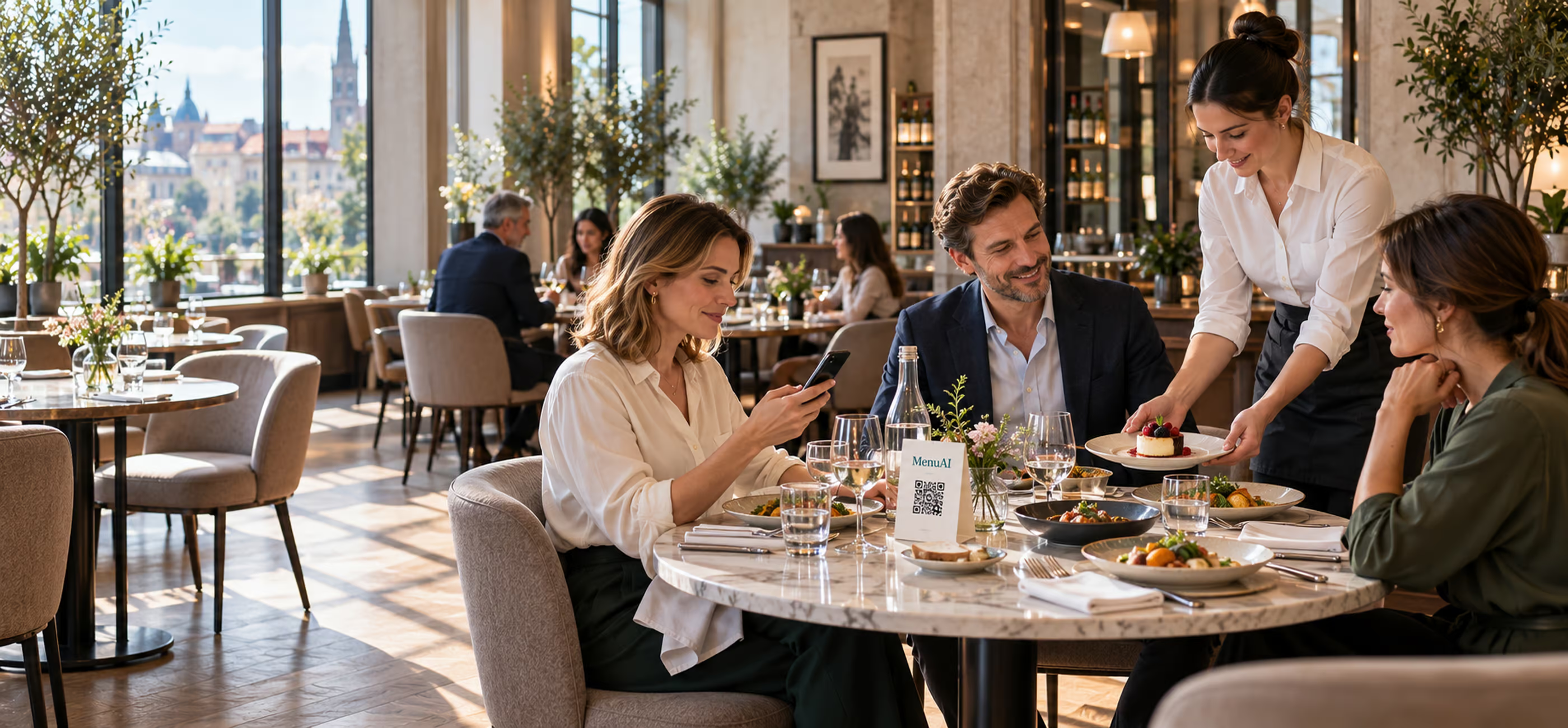
A guest studying the lunch menu asks whether the aubergine dish is filling enough on its own.
“It comes with lentils and flatbread,” the waiter explains. “It’s a proper main course.”
The guest orders it without adding anything.
A few minutes later, another table asks for something small to share while they decide on their mains. The waiter suggests the marinated peppers, mentions the price and brings a plate.
One table spends more. Both receive good service.
That distinction matters when you're trying to increase average spend in a restaurant. A useful recommendation can improve a meal and add to the bill. An unnecessary one can make guests feel that every conversation is an attempt to sell them something.
For an independent restaurant, the opportunity isn't to persuade every customer to order another course. It's to notice when there's something genuinely worth suggesting — and make it easy for the guest to decide.
Why “Would you like anything else?” rarely helps
It's one of the most familiar questions in restaurant service, often asked just before the waiter leaves the table.
There's nothing inherently wrong with it. But it puts all the work back on the guest.
What else is available? Does the main course already include potatoes? Is there something suitable for sharing? Will another dish take too long? How much will it cost?
A guest who has finished choosing may simply say no rather than open the menu again.
Staff face the opposite problem. They know the menu but have very little time to decide what, if anything, to recommend. During a busy lunch service, the easiest response is either a generic question or no suggestion at all.
Neither tells the guest much.
A better approach starts with what the customer is already trying to decide.
Imagine this conversation in a neighbourhood bistro:
Guest: “Is the mushroom and barley dish enough for lunch?”
Waiter: “Yes, it's a full main with roasted squash. If you'd like something fresh alongside it, the tomato salad is €5.”
Guest: “I'll stick with the main, thanks.”
Waiter: “Of course.”
The waiter has explained the dish, offered a relevant option and accepted the decision. There's no need for a second attempt.
The recommendation also hasn't undermined the main course by suggesting it is inadequate.
That is an important difference. Customers should be able to order the meal advertised without feeling that essential parts of it cost extra.
Now consider an evening table.
Guest: “We'd like something to share while we look at the menu.”
Waiter: “The marinated peppers are €7. They're ready to serve, so I can bring them while you decide.”
Guest: “That sounds lovely.”
Here, the suggestion answers a specific request. The waiter knows the kitchen can fulfil it, the price is clear and the additional dish fits the occasion.
These aren't lines for staff to memorise. They're examples of what happens when somebody understands the menu well enough to give a useful answer.
Give staff something worth recommending
Some restaurants ask their team to sell more without giving them the information needed to make a sensible suggestion.
The menu has changed, but the briefing hasn't. The most profitable side dish takes too long to prepare at lunchtime. A dessert featured in yesterday's recommendation has already sold out.
The result is predictable: staff either repeat the same safe suggestion or stop offering anything.
Before encouraging more recommendations, give the team a few useful facts.
For each popular main course, they should know what is included, which optional accompaniment genuinely works with it, its selling price and whether the kitchen can prepare it comfortably during service.
There's no need to give every dish five suggested extras. One good pairing is more useful than an exhausting selection.
A small restaurant can make this part of the pre-service conversation. The manager might choose two dishes worth mentioning that day and ask the kitchen whether it can handle additional orders.
The front-of-house team also needs permission to recommend nothing.
If someone says they're in a hurry, has already chosen a complete meal or is clearly ready to order, selling an additional course may be the wrong decision.
Good staff don't need to turn every interaction into an opportunity. They need to recognise the opportunities that actually make sense.
Make the menu do some of the explaining
A waiter should not have to explain the same basic facts about a dish at every table.
If customers repeatedly ask whether the fish comes with potatoes, the menu description may be incomplete. If nobody notices a side dish until the waiter mentions it, its placement may be unhelpful.
These problems can often be fixed without changing recipes or prices.
Start by checking what the menu tells someone who has never visited your restaurant.
Does it distinguish the ingredients included in the main course from optional additions? Can guests find side dishes without searching through several unrelated sections? Are portion sizes and prices understandable? Are the photographs accurate representations of what is served?
A photograph of a complete meal that includes several separately priced extras can create a misleading impression unless the distinction is made clear.
The same applies to descriptions. “Served with roasted potatoes” means something quite different from “Roasted potatoes available as an extra”.
Good menu presentation removes uncertainty before the guest has to ask.
A well-chosen accompaniment can sit alongside the dish it complements, with its price shown. It shouldn't appear as a compulsory upgrade or be added by default.
This is particularly useful when guests prefer to browse independently.
Where a digital menu helps
With MenuAI's digital menu, a restaurant can present dishes with descriptions, ingredient and allergen information, and relevant recommendations for additional items.
A guest looking at a main course can see a suitable accompaniment and decide whether to include it, without needing a waiter to deliver a sales pitch. The choice remains theirs.
The manager can also update the menu and mark an item unavailable when the kitchen runs out. That matters because suggesting something the restaurant can no longer serve creates inconvenience rather than additional sales.
The operational rule is simple: whoever is responsible for the menu must keep availability and descriptions accurate. A digital recommendation is only useful while the item is genuinely available.
Staff should remain available for questions and for customers who prefer not to use a smartphone. Ingredient and allergen information is especially important: the menu helps guests understand their options, but staff still need to check individual concerns with the kitchen, including possible cross-contact.
Digital presentation makes the choices easier to find. It doesn't replace judgement about which choices are worth offering.
The expensive mistake of selling an extra course at the wrong time
The same recommendation can make sense at seven in the evening and cause problems at half past twelve.
During a quiet dinner service, a shared starter may be a welcome addition. Guests have time to enjoy it, and the kitchen can prepare it without delaying the mains.
During a short lunch rush, that starter may occupy a table and a cooking station for longer than the restaurant can comfortably manage.
The extra sale looks positive when you examine the bill. It may look less attractive when you consider the whole service.
Suppose a small bistro is full between 12:30 and 14:00. Its customers include office workers who expect a relatively quick meal.
Encouraging extra courses at every table could mean more preparation, longer waits and fewer opportunities to seat customers who arrive later.
None of those consequences is inevitable, but they need to be considered.
A better lunchtime suggestion might be something that accompanies the main course without adding another preparation stage. A ready-to-serve side, a drink or a small existing accompaniment may fit the kitchen's workflow more easily.
The evening team can take a different approach, giving guests time to consider starters, desserts and drinks when the pace of service allows.
The point isn't to create rigid rules about which courses should be sold at particular times. It's to judge the recommendation against the kind of experience the customer wants and the capacity of the restaurant.
A larger bill is not necessarily a better result if it comes at the expense of another table, a delayed kitchen or an irritated guest.
Average check and spend per guest are not the same number
Before deciding whether recommendations are working, make sure you're measuring the right thing.
Restaurants often use average check and average spend per guest as though they mean the same thing. They don't.
Average check is sales divided by the number of transactions or bills.
Average spend per guest is sales divided by the number of customers served, often recorded as covers.
For example, imagine a restaurant records €1,200 in sales excluding VAT during one lunch service. It serves 60 guests and closes 30 bills.
- Average check: €1,200 ÷ 30 = €40
- Average spend per guest: €1,200 ÷ 60 = €20
Neither figure is wrong. They answer different questions.
If guests begin paying separately rather than settling one bill per table, the number of transactions can rise without anyone spending more.
Similarly, a service with larger groups may produce higher bills simply because more people are eating together.
If your goal is to understand what individual guests spend, track revenue per cover. Keep average check as a separate measure of transaction value.
In both calculations, use the same accounting basis: the example uses sales excluding VAT. Don't compare VAT-inclusive figures from one period with VAT-exclusive figures from another.
For a café or takeaway business that cannot reliably count individual customers, transaction value may be the more practical measure. Just don't relabel it as spending per guest.
An extra €6 in sales is not €6 in profit
Consider an optional side dish that generates €6 in additional sales excluding VAT.
The restaurant must still purchase the ingredients, prepare the dish and serve it.
Here's a purely illustrative calculation for one extra side:
| Item | Amount |
|---|---|
| Additional sales, excluding VAT | €6.00 |
| Ingredients | −€2.00 |
| Other direct consumables | −€0.20 |
| Additional paid labour, where incurred | −€0.40 |
| Contribution before fixed costs | €3.40 |
This example assumes the extra work genuinely creates €0.40 of variable labour cost. If the same employees prepare the side within their existing paid hours, that amount should not be treated as a new cash expense merely because they spent time on it. The workload still matters.
No takeaway packaging is included because the example concerns a dine-in order. If an extra item requires packaging, a delivery fee or another variable service cost, include it.
The remaining €3.40 isn't net profit. It contributes towards rent, existing staffing, utilities and other fixed costs before any eventual profit.
And the calculation assumes the kitchen can fulfil the order without causing a more costly delay elsewhere.
This is why choosing an add-on solely because it has a high selling price can be a mistake.
An inexpensive side that the kitchen can prepare reliably may make a better recommendation than an elaborate extra dish with higher sales revenue but more food cost, waste and preparation time.
If the figures aren't available, start with the recipe and purchase prices rather than guessing at a margin. Menu pricing decisions deserve their own calculation; they shouldn't be made simply because an additional item sells well.
Test one recommendation before changing the whole menu
It's easy to announce a new approach on Monday and look at Friday's higher sales as evidence that it worked.
But perhaps Friday had more evening tables, larger parties or a different menu mix. Perhaps the weather changed, a local event attracted customers or a particularly popular dish returned.
Before drawing conclusions, give yourself a fair comparison.
Take one established main course that sells regularly. Choose a relevant accompaniment that the kitchen can prepare consistently, and make sure its price and description are clear.
For a few comparable services, record how often customers order the combination without a new recommendation. Then introduce one change: perhaps a clearer menu description or a specific staff suggestion.
Don't change the price, photograph, portion and staff wording all at once. You won't know which change mattered.
Track the number of orders in which the main course was eligible for the extra, and how often the extra was actually chosen. This is more informative than simply counting total side dishes sold.
Also record whether the new combination causes delays, extra waste or repeated refusals. An increase in sales may not be worth keeping if it creates another problem during service.
Compare like with like: weekday lunches against weekday lunches, evenings against evenings, and similar menu conditions wherever possible. A short trial in a small restaurant can't establish a universal causal effect, but it can reveal what deserves a closer look.
And ask the staff what happened. Did customers understand the offer? Was it easy to explain? Did it feel helpful or awkward? Did the kitchen struggle?
You can do this with a notebook and existing sales records. There's no need to buy a new system just to find out whether one accompaniment is worth offering.
The customer should still feel free to say no
There is a reason good restaurants develop regular customers.
Guests return for food, certainly, but also for the feeling that the people serving them understand what kind of experience they want.
Someone may want a quick, inexpensive lunch. Someone else may be celebrating and welcome suggestions they wouldn't normally consider. A family may appreciate a side dish that can be shared. A customer may simply want exactly what they've ordered.
None of those guests should have to defend their decision to decline an extra.
For the next service, start with two popular main courses. Ask the kitchen to identify one optional pairing for each, check its direct costs and preparation demands, and make the price unmistakable. Brief the team to recommend it only when it fits the guest's order. Then compare take-up, contribution and any delays across similar services. Keep the suggestion only if it earns its place.
Increasing average spend through better recommendations is therefore less about training staff to sell and more about making the menu easier to understand, the kitchen's capabilities clearer and the service more attentive.
Start with one question: What could we recommend that would genuinely make this particular meal better?
Sometimes the answer is a side dish, another drink or a dessert.
Sometimes it's nothing.
Knowing the difference is what makes a recommendation worth listening to.