
 EN

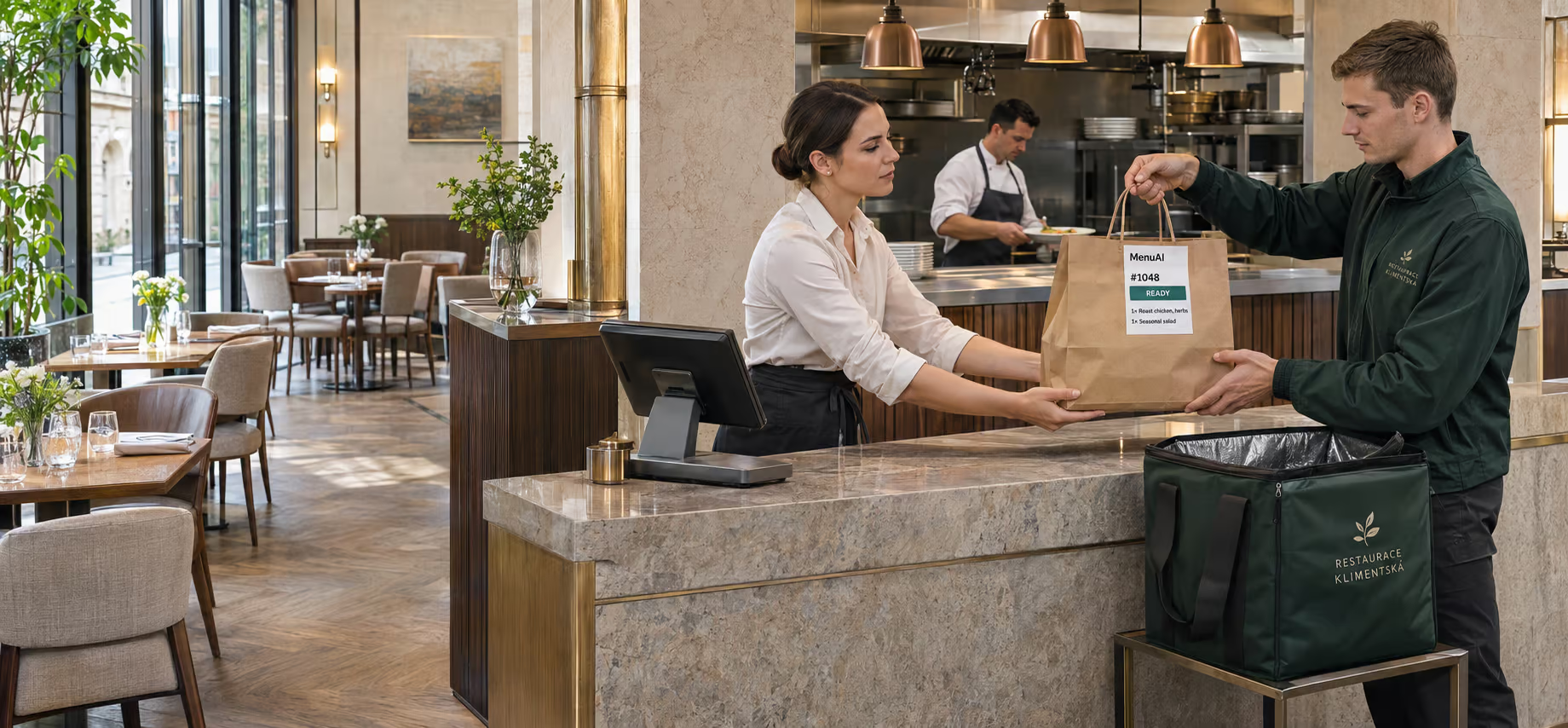
It's nearly closing time on a Friday. The kitchen has packed its last takeaway, the delivery tablet is finally quiet, and a neighbourhood restaurant manager is looking at the evening's orders. Business was brisk. There were plenty of €40 and €50 baskets. The platform dashboard looks encouraging.
Then comes the less satisfying part: working out what those orders actually left behind.
The customer's receipt isn't the restaurant's payout, and the payout isn't profit. The food cost money to make and pack; promotions, commissions and late collections have their own costs.
For a small business, the decision isn't simply whether delivery apps charge too much. It's whether the restaurant is buying worthwhile access to customers — and whether it could serve some of those customers more economically through its own ordering and delivery operation.
The order total is the beginning of the calculation
Start with one completed delivery order, not the total displayed at the top of a weekly report.
Use actual sales revenue excluding VAT and after restaurant-funded discounts. Then identify ingredients, packaging, payment charges, commission, paid promotion and any delivery costs the restaurant bears.
Match the platform statement to the order. Check the commission base and whether visibility, promotions, payments or delivery services carry separate charges. A restaurant-funded discount isn't the same expense as one funded by the platform.
Don't deduct a discount twice, or compare a platform courier with a supposedly cost-free direct delivery. Both distort the result.
The following example deliberately uses the same meal, same selling price and same discount in both channels. It is a teaching example, not a quotation of any Irish or European platform's fees.
One €50 meal, two ways to deliver it
The food is priced at €50 excluding VAT. The restaurant gives the customer a €2 discount in either channel, leaving €48 in sales. The guest pays no separate delivery charge in either scenario. The cost of ingredients is €16, packaging €2, and payment processing is assumed to cost €1 in both cases. Costs exclude recoverable input VAT. Actual payment contracts need not work this way; holding the figure constant makes the delivery comparison easier to see.
For the platform order, suppose the agreement charges 25% of the €48 sale: €12. In this illustrative contract, the platform's last-mile delivery service is already covered by that charge, with no additional courier fee for the restaurant. There are no extra paid platform services in this example.
For the direct order, there is no third-party marketplace commission on that order. Instead, the restaurant spends €7 on its own delivery fulfilment, €2 on acquiring or retaining the direct order, and €1 on other variable work associated with that channel.
| Per completed order, excluding VAT | Delivery platform | Direct order with own delivery |
|---|---|---|
| Food price before restaurant discount | €50.00 | €50.00 |
| Restaurant-funded discount | −€2.00 | −€2.00 |
| Restaurant sales after discount | €48.00 | €48.00 |
| Ingredients | −€16.00 | −€16.00 |
| Packaging | −€2.00 | −€2.00 |
| Payment processing (illustrative) | −€1.00 | −€1.00 |
| Platform commission (25% of €48) | −€12.00 | €0.00 |
| Own courier and delivery fulfilment | €0.00* | −€7.00 |
| Direct customer acquisition or retention | €0.00 | −€2.00 |
| Other direct-channel variable operations | €0.00 | −€1.00 |
| Contribution after these variable costs | €17.00 | €19.00 |
The platform's delivery service is included in the assumed commission for this example; the restaurant is not paying for a second courier.
Both orders leave €29 after their common variable costs (€48 − €16 − €2 − €1). The platform takes €12 of that amount; the direct channel uses €10 for delivery, acquisition and other order-specific work. The direct order therefore leaves €2 more contribution if it is genuinely the same order placed through a different channel. That is not €2 of net profit. Neither column covers the restaurant's fixed overheads, and the figures do not include any new fixed costs of operating a dedicated delivery service.
Change one condition and the result reverses.
One long courier trip can reverse the result
Suppose the customer lives further away. Instead of €7, fulfilling the direct order costs €11. Keeping everything else unchanged, the direct contribution falls from €19 to €15 — €2 below the platform example. At €9 in own-delivery costs, the channels tie at €17 per order under these assumptions, before any extra fixed costs.
Delivery radius and order density matter as much as commission rates.
Two nearby deliveries can be economical; one long journey may not be. Waiting, return trips and failed handovers consume paid time, while the kitchen still has to cook and pack every order.
Before promising delivery across a city, map where customers live, when orders arrive and which trips can reasonably be grouped without harming food quality. Some streets and time windows may suit your own couriers; others won't.
You also need to distinguish a cost per delivery from a cost you incur regardless of sales. If a courier is paid for a whole shift, include the relevant paid time, including idle periods, when assessing the service. If you already counted that shift cost, don't add it again as though every delivery incurred an entirely separate wage. Bikes, insurance, equipment, management time and subscriptions may introduce further costs; record them where they belong rather than hiding them inside an optimistic average order.
Your own delivery operation also needs enough orders to cover any additional fixed costs. For example, suppose operating it adds €300 a month on top of all the per-order expenses already counted. At just €2 extra contribution for a genuinely shifted order, the restaurant would need 150 comparable orders a month switched from platform to direct merely to cover that €300. That is a break-even illustration, not a prediction of how many regulars will switch. Nor should courier wages or equipment be deducted again if they are already included in the €7 fulfilment charge.
Not every platform order is an order you could have won yourself
Now look at two customers.
The first lives around the corner, has ordered from the restaurant several times and knows its name. Next Friday, they might be perfectly happy to use the restaurant's own ordering channel. If that same sale switches from platform to direct ordering, comparing €17 with €19 in the example is a sensible starting point — provided the customer and fulfilment costs really match the assumptions.
The second has never heard of the restaurant. They find it while browsing a delivery app. Without the platform, there might have been no order at all.
In that case, the relevant comparison isn't automatically €17 against €19. It's whether the additional platform order's €17 contribution helps cover the restaurant's costs, considering any extra workload or capacity it displaces. If the kitchen is otherwise quiet and the order creates no costly disruption, that contribution may be valuable even though the direct channel would have a better margin on a sale the restaurant already had.
If the kitchen is at capacity and a platform order delays several existing customers, the calculation becomes less favourable. The extra order might displace another sale or impose service costs that are missing from the simple table.
There is no need to turn this into a competition in which one channel must win everywhere. Delivery marketplaces can be useful for discovery. Direct ordering can be particularly worthwhile for returning guests, repeatable local demand and a delivery area the restaurant understands well.
You cannot know from a ticket alone whether a platform customer would otherwise have ordered direct, or whether a regular would switch. Test those assumptions.
And before creating direct-only promotions or contacting customers acquired through a platform, check the applicable contract terms and data-use permissions. The Austrian Federal Competition Authority's 2026 inquiry into delivery platforms identified exclusivity and pricing clauses in parts of that market. Its findings concern Austria; they are a reason to read your own agreement, not evidence that every European platform imposes the same conditions.
Give the numbers a proper test before hiring a courier
Sample completed orders from both busy and quiet periods. Use comparable meals, and reconcile the order records with the platform settlement.
Price the equivalent direct order using realistic courier time, distance, packaging, payments and customer acquisition. Don't build the model around a rider who is magically available whenever an order arrives.
Change one assumption at a time: a nearby versus distant address, or Tuesday versus Friday. Include material cancellations, refunds and failed handovers.
You can put your own figures into MenuAI's free Delivery Profit Calculator to compare delivery channels without relying on the sample costs in this article. It is a calculation tool, not a substitute for knowing your courier arrangements or identifying where new orders actually come from.
The sensible first move may be direct delivery to a limited area, not the whole city.
A direct ordering channel still needs a delivery operation
Owning the ordering relationship isn't the same as managing the last mile.
The restaurant still has to check availability and delivery coverage, prepare the food and organise the courier handover. When a dish sells out or a delivery goes wrong, someone must deal with the exception. An attractive digital menu cannot make those decisions on its own.
MenuAI brings together a restaurant's direct digital ordering channel and a professional module for organising its own delivery. A guest orders from the restaurant's digital menu rather than through a marketplace. Staff maintain item descriptions and availability, process the incoming order and use MenuAI's own-delivery module to organise its fulfilment. When a dish sells out, the team can update its availability rather than keep accepting orders it cannot prepare.
The operational responsibilities still matter: the kitchen confirms readiness, staff check the address and arrange handover, and the restaurant sets a delivery area and capacity it can serve reliably. MenuAI gives the business a way to manage its own orders and delivery process; it does not supply the courier or remove the need to coordinate the kitchen.
A direct MenuAI order does not incur a third-party aggregator's intermediary commission for that order. It still incurs the costs of making the food, delivering it, taking payment, finding customers and running the service. The financial advantage, if any, depends on those costs and on the demand the restaurant can generate.
Direct ordering can serve repeat business; platforms may remain valuable for discovery. Running both can be a sound choice.
Frequently asked questions
If customers pay a delivery fee, does that improve the restaurant's contribution?
Only if the restaurant actually receives that fee. Add the amount retained by the restaurant to its revenue, on a consistent VAT basis; account separately for courier costs. A delivery charge collected and retained by a platform isn't automatically restaurant income.
Should a restaurant use a higher price on delivery apps to cover commissions?
A different price changes demand as well as the arithmetic, and platform contracts may restrict pricing or promotions. First calculate contribution at the prices customers actually pay and review your contractual and local obligations. Don't assume a higher app price will leave order volumes unchanged.
Is an employed driver cheaper than paying for each delivery?
Not necessarily. A busy run may make a paid shift economical, while long idle periods can make it expensive. Compare the driver's total relevant paid time and other employer costs with the number of deliveries the business can realistically fulfil. Never count the same wages both as full shift expenditure and again as a separate per-order charge.
How can we compare channels when some guests collect their own food?
Keep collection, platform delivery and own delivery as separate fulfilment scenarios. A customer collecting a direct order usually removes the last-mile courier expense, but the payment, packaging and order-handling costs may still differ. Compare equivalent meals on equivalent sales and VAT bases before drawing conclusions.
The right channel is the one that earns its place
After the next busy delivery shift, don't ask only how much the apps sold. Ask how much contribution was left by order type, which deliveries absorbed the courier's time, and whether customers in the nearby streets have a convenient way to order from you directly.
If you have regular guests within a manageable delivery radius, test a direct service there first. Make sure the kitchen can handle it. Keep the platform channel where it brings worthwhile new business. Compare the results on the same sales and cost basis, and reconsider the arrangement when order density or costs change.
For restaurants ready to operate their own channel, explore MenuAI's ordering and delivery capabilities, create a MenuAI account or review the available plans. The starting point, however, is still the economics of your particular orders — not somebody else's commission percentage.